
Secure your code, cloud, and attack surface — in one platform
Instant external scans and continuous monitoring — for teams focused on data safety and secure development without breaking the budget
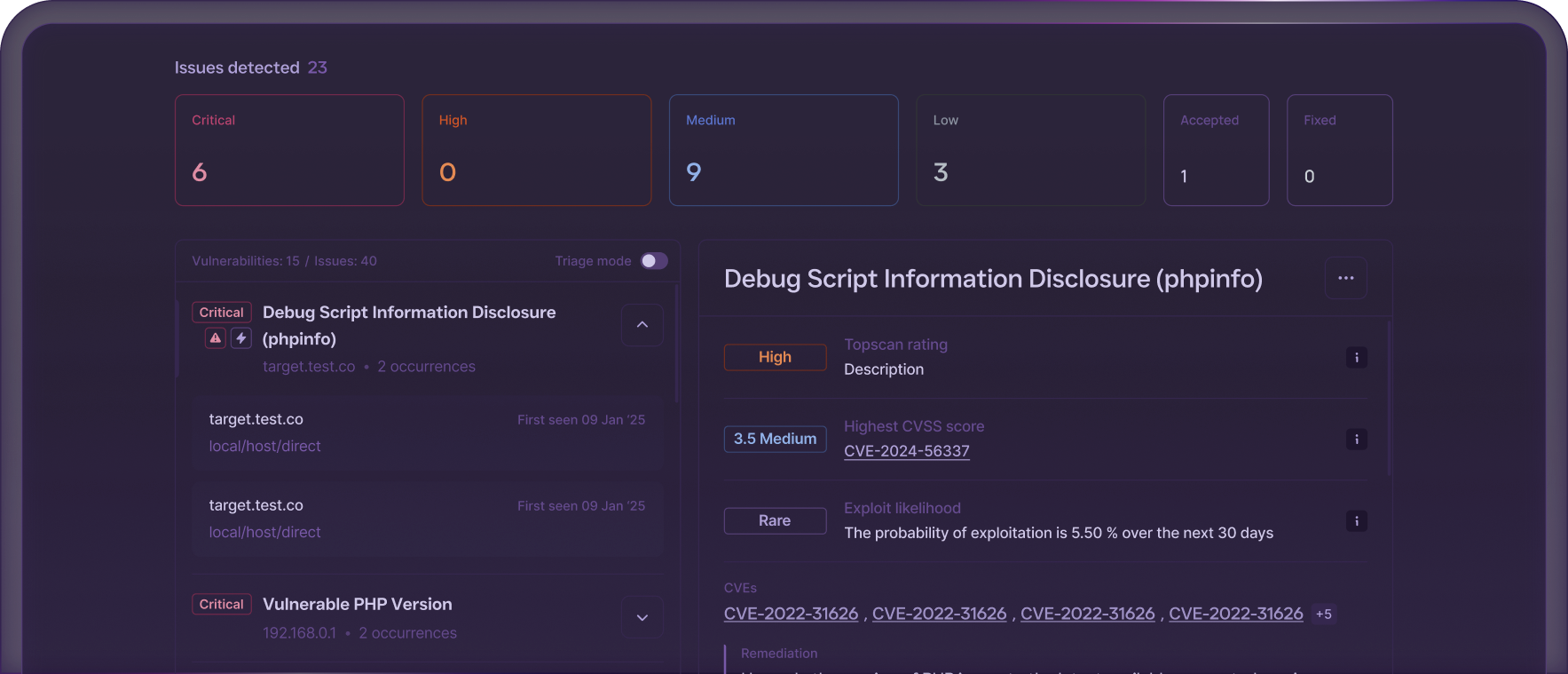
Security across your entire pipeline — from code to attack surface
Most tools secure a single stage. Topscan covers them all — static analysis in your code, dynamic scanning in production, and continuous monitoring of everything exposed to the internet
Catch vulnerabilities in your source code before they ever ship
Gate every build. Block risky releases automatically
Surface misconfigurations across your cloud infrastructure
Scan live services for vulnerabilities, expired certs, and weak TLS
Discover new hosts and watch your external attack surface 24/7
Catch vulnerabilities in your source code before they ever ship
Gate every build. Block risky releases automatically
Surface misconfigurations across your cloud infrastructure
Scan live services for vulnerabilities, expired certs, and weak TLS
Discover new hosts and watch your external attack surface 24/7
One subscription,
not three
Covering your pipeline usually means paying separate vendors for SAST, DAST, and attack-surface monitoring — three contracts, three bills, three tools to wire together. Topscan replaces them with a single subscription
Code monitoring, CI/CD
Web app & Infrastructure scanning & monitoring
Attack surface monitoring
from
$129/month
Save $328/month vs paid SAST + DAST + ASM stack

- SAST — code monitoring
- DAST — web app & infrastructure scanning
- ASM — subdomains, ports, exposed services
- SLA Tracking
- Task manager integrations
- Continuous scanning
- Unlimited users & scans
Code monitoring, CI/CD
Web app & Infrastructure scanning & monitoring
Attack surface monitoring
from
$129/month
Save $328/month vs paid SAST + DAST + ASM stack
- SAST — code monitoring
- DAST — web app & infrastructure scanning
- ASM — subdomains, ports, exposed services
- SLA Tracking
- Task manager integrations
- Continuous scanning
- Unlimited users & scans
* AWS Cloud integration is available on Advanced and Pro plans
Five minutes to <start> your security scans
Quick start: Sign up with Google or Github. Just 5 min from registration to the first scan!
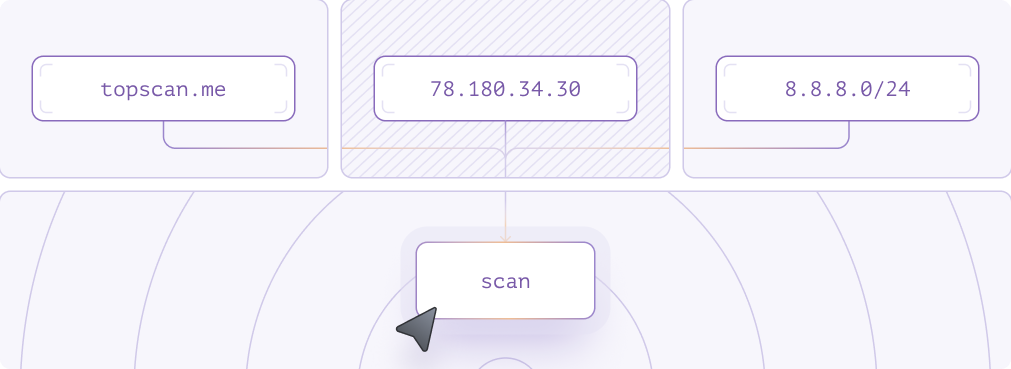
Fast setting a scan: add your targets (IP, CIDR, domains), and start scanning
Yes, even <for free>
14-day trial with full functionality. No card required!
Just register and start full functional vulnerability scans.
Attack surface discovery, always <up to date>
Auto-discover services, IPs, sub-domains, and cloud endpoints & Add them to your scan list and dashboard without manual work
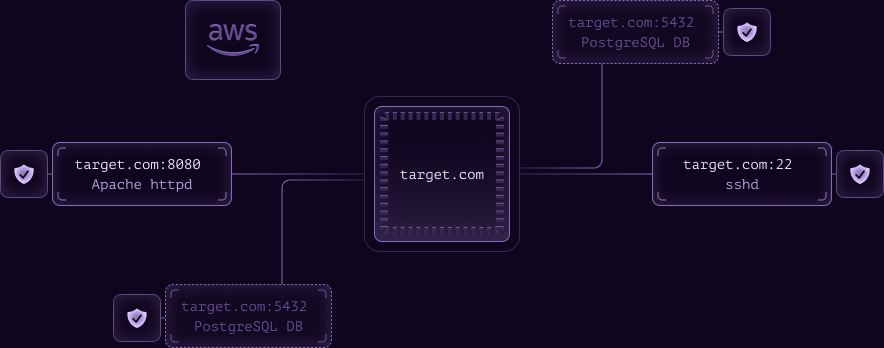
Integrate scans directly in your <pipeline> and run them with <webhooks>

Fair pricing for <your security>
From startups to enterprises — one fair model for all security teams

Pay per target,
not per user or scan

Unlimited rescans
and free read-only seats for auditors
FAQ
Topscan builds on the best in class scanning engines
Still have questions?
Contact usPricing is per target bundle, so this matters before anything else. A target is a domain or an IP you add to monitoring, or a repository for code scanners. Any subdomain (as a web application) is a separate target. Regarding code scanning: one repo - one target. Without any pitfalls. Rescans are unlimited, users are unlimited, and read-only seats for auditors are free.
You can, and we run them too — the engine isn't the product. Running a scanner is a Tuesday afternoon. Knowing that a new staging.admin appeared last week, that a certificate expired 41 days ago, and that a host you'd forgotten was quietly answering the whole time — that's a system, not a scan. Topscan keeps the inventory, watches it continuously, tracks what you accepted versus fixed, and holds the evidence an auditor asks for.
No for external scanning — you add a domain or IP and it starts. SAST connects to your repository, CI/CD gating goes through a webhooks, and AWS misconfiguration checks use a read-only role. Nothing runs on your servers.
A pentest is a deep look on one day. This is a shallow look every day. A pentest tells you how far someone could get; continuous monitoring tells you what changed since Friday. Most incidents start with something that appeared after the last release.
That's what most teams use it for. Auditors ask for evidence of regular scanning and an inventory of what's exposed — both are produced automatically, and auditor seats are free and read-only.
Every finding ships with the evidence that produced it — hostname, status code, response banner, certificate date — so you can verify it in a second. Mark it as a false positive or snooze if you would like to postpone it, and it stops resurfacing. We'd rather report less and be checkable than report more.
You authorise scanning when you add a target and confirm ownership. Default discovery uses public registries, DNS and a single ordinary HTTP request. Port scanning and active vulnerability templates run only on targets you've explicitly confirmed — that boundary is deliberate, because in some jurisdictions an unauthorised port scan is a criminal matter.
Customer data is stored in the Hetzner cloud in Ashburn, Virginia, US. None of the developers have access to the production environment; only the Head of DevOps has access, and all his actions are logged. No customer data leaves our infrastructure or is transmitted to third-party systems (such as 3rd party AI services); all operations take place within a closed environment.
We are currently undergoing a SOC 2 audit and monitoring our processes via Drata.
In the event of account deletion, all data will be permanently removed from our servers within 180 days.